South from Husum and Schobüll, on the peninsula of Eiderstedt, in Tönning there is the Multimar Wattforum. It is more than a mere museum, it is abouth whales and mudflat and the nature in this special part of the world.
Polly was curious to learn more about fishes and mammales of the sea.
The first stop was the exhibition about whales. This is amber, real amber. It was found drifting in the water, which happens from time to time.
And these are whalebones, that were used for example for corsetts.
The skeletons are real bones. The big whale is a cachalot, the small one a finback.
The teeth of a whale tells how old the whale was. It's build in rings like trees. There was a room where one can listen to the songs of different whales as humpbacks, dolphins, orcas...
They've got aquariums there, too. In the biggest one live rays. So here is the riddle: where is the ray on the lower pic?
After three hours of intense fish watching, hearing, reading and learning Polly was tired and out. And so were we. It was a great experience and we will turn back one day.
The next day we returned to visit the town of Tönning. It is a small town with a famous storage house.
Every year they use it as an advents calendar.
Here are some impressions from Tönning:
Once there was a castle, but it was demolished on demand of a danish king.
This is a model of the castle. It is said that it was the most beautiful castle in the duchies of Schleswig and Holstein.
This is the lutherian church. After lunch we went on to the Eidersperrwerk. The Eider is a strange river: She starts in Holstein and takes her course to the Baltic Sea but directly at the border to Kiel she turns and crosses the land. At Tönning she reaches the North Sea.
The flood barrier shall keep storm floods away. On the sea side it was very windy, yes, even stormy. On the land side it was far calmer.
While we were watching the sea swallows, the bridge opened to let a ship pass.
The sea swallows were still feeding their offspring.
Between the flood barrier and Tönning lies the Katinger Watt, a nature reservation. It is important for many birds and flowers.
Cows hold the landscape open and munch bushes, which otherwise would overgrow the meadows.
Back on the farm I took Sirpa for a walk to visit the cows.
We went on the dike to watch out for the weather.
It was a wonderful evening with the sun breaking through and beautiful clouds.
Sirpa took the chance to climb in the little oak tree.
Samstag, 5. September 2015
Freitag, 4. September 2015
Summervacation Part 3
No visit in Schobüll is complete without a walk in Schobüll forest. It is on Schobüll mountain which measures impressive 33m over sea level. Your mountains are higher? I'm not impressed.
After the strong storms of 2013 and 2014 there is lot of free space for flowers and young trees.
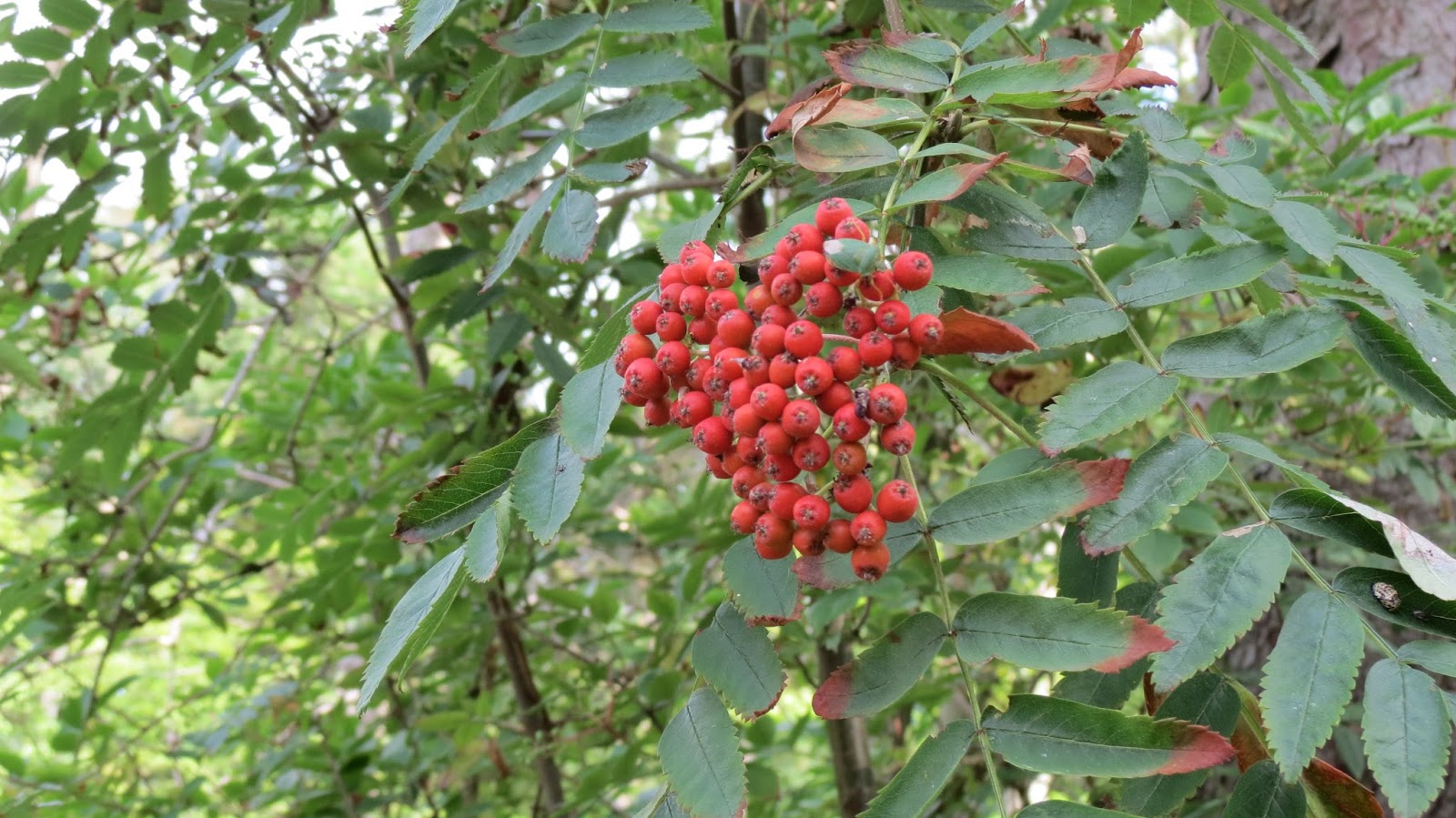
The rowan berries are almost ripe. You can make delicious jam from them, but you shouldn't eat them raw. If you're not a bird, of course.
The wren is one of our smallest birds but he is the loudest for sure. The dead tree's roots were the perfect place to tell the world that this is his part of the world.
Punky found mysterious signs and decided to follow them.
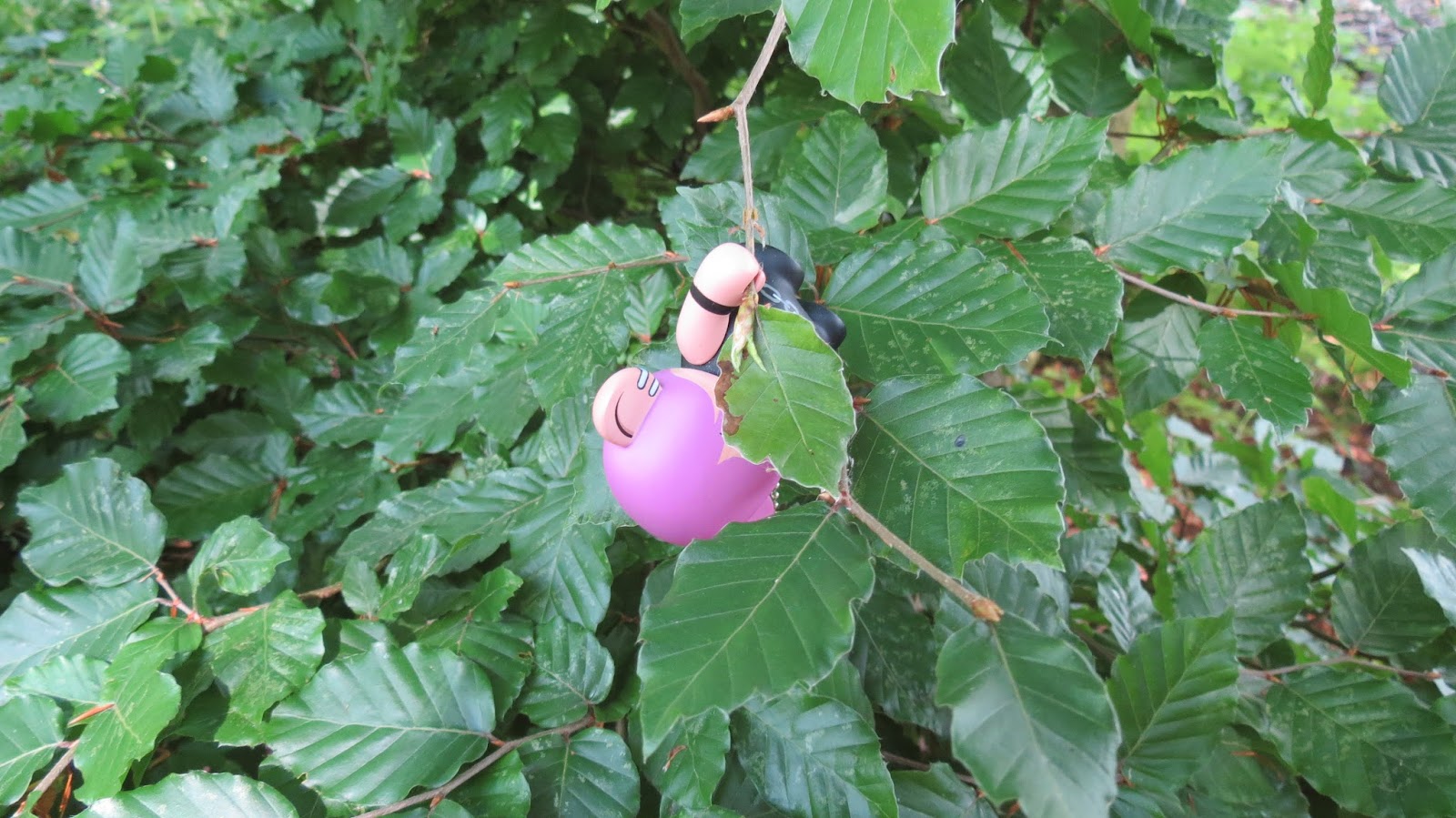
She thought she could climb at least as good as Tarzan.
Nope.
Weather got worse. We had a fabulous thunderstorm.
Inkeri was afraid of all the loud rolling thunder but Sirpa was fascinated. She sat by the window all day long hoping for more lightning.
Small animals are sooo cute and calves are no exception to that rule. The cow with the heart on her brow was the last one to get her calv.
We went also to Nordstrand. Nordstrand is part of the old island Strand which break in several parts in the floods of the 14th to 17th century. Nowadays it is more a peninsula as a dam has been build.
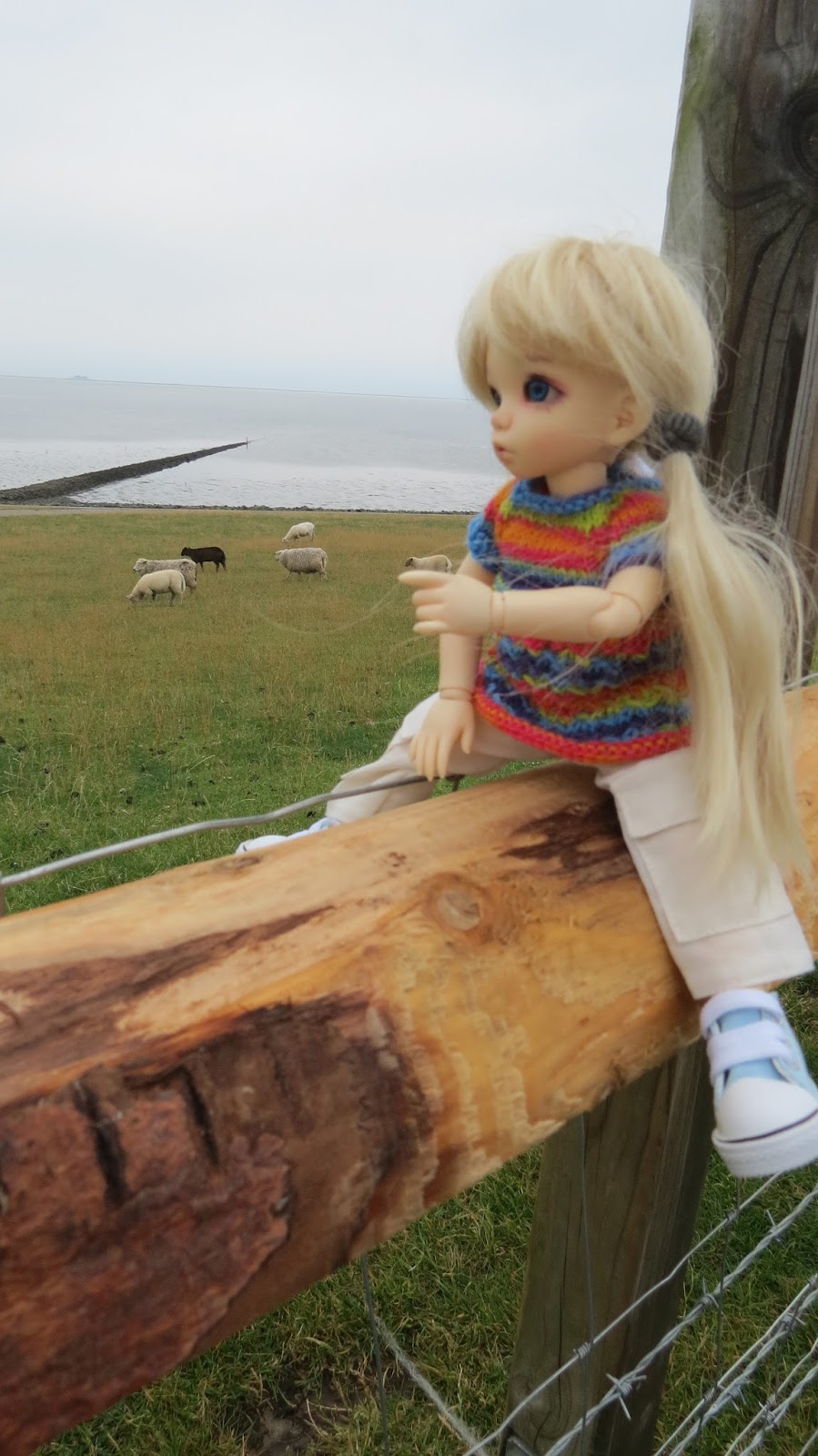
Inkeri loved watching the sheep. But they were by no means as tame as "ours".
Next stop was Strucklahnungshörn, where the ships depart for Pellworm. Pellworm is also a part of Strand but still an island.
Here it started to rain but Inkeri wanted her picture taken with the boats. The white one is "Eiswette", one of the sea rescue boats of the DGzRS, the german SAR-organisation.
It was raining hard when we came back. Very hard. Poor cows.
After the strong storms of 2013 and 2014 there is lot of free space for flowers and young trees.
The rowan berries are almost ripe. You can make delicious jam from them, but you shouldn't eat them raw. If you're not a bird, of course.
The wren is one of our smallest birds but he is the loudest for sure. The dead tree's roots were the perfect place to tell the world that this is his part of the world.
Punky found mysterious signs and decided to follow them.
She thought she could climb at least as good as Tarzan.
Nope.
Weather got worse. We had a fabulous thunderstorm.
Inkeri was afraid of all the loud rolling thunder but Sirpa was fascinated. She sat by the window all day long hoping for more lightning.
Small animals are sooo cute and calves are no exception to that rule. The cow with the heart on her brow was the last one to get her calv.
We went also to Nordstrand. Nordstrand is part of the old island Strand which break in several parts in the floods of the 14th to 17th century. Nowadays it is more a peninsula as a dam has been build.
Inkeri loved watching the sheep. But they were by no means as tame as "ours".
Next stop was Strucklahnungshörn, where the ships depart for Pellworm. Pellworm is also a part of Strand but still an island.
Here it started to rain but Inkeri wanted her picture taken with the boats. The white one is "Eiswette", one of the sea rescue boats of the DGzRS, the german SAR-organisation.
It was raining hard when we came back. Very hard. Poor cows.
Abonnieren
Posts (Atom)